

International Master’s Degree Programs: Why They Are the Perfect Way to Move Abroad
Answering community questions and spotlighting international scholarships and schools for your ticket out of here 🎟️



On April 26th, I attended an international Master’s degree fair with Unimy in Bangkok, Thailand. With education visas being one of the fastest and simplest ways to move abroad, and with so many folks within the BBA community interested in pursuing higher education abroad, I had to see what was up. Thank you so much to the community members who responded to the call-out in our chat for questions you’d like me to ask, and I got answers for you!

This fair was mostly for students who were preparing to graduate from university and wanted more information about graduate programs, so a lot of attendees were on the younger side.
That being said, there is no age limit on getting into graduate school! You also don’t need to have amazing grades in a college you attended 5, 10, or 20 years ago to enter school. For working adults, your work history, letters of recommendation, and other items will likely be asked of you, especially if it’s been years since you attended school. All of the schools discussed below are English-speaking schools, and there is an English proficiency test for non-native English speakers.
I’ll dive more into the details of each school below, but I wanted to emphasize that there are countless other international graduate programs around the world. Let this article, the discussion topics, and Candace’s prompts at the bottom inspire you to look into these programs and/or others that might better suit your needs.
Now, let’s cover the basics and benefits…

Benefits of getting an international Master’s degree for folks who want to live abroad 🌍
This is definitely not an exhaustive list, but there are tons of upsides to going the route of snagging an international Master’s degree. Candace has studied abroad at both the Bachelor and Master-level, and she still sees the gold nuggets this has afforded her, both in life and career.
So here are some reasons you should consider an international Master’s program (especially if you want an easy ticket out ✈️):
Study programs are often the most straightforward and quick visas to obtain
With your program, you will be afforded a long-term visa for living abroad
You can access higher education in a subject you are passionate about (and there are so many dynamic and diverse studies available globally!)
Studying abroad through a university can offer you an international and local community to support you as you adjust to life abroad
There are tons of scholarships and financial support opportunities for Master programs, possibly lightening the moolah load of moving abroad
You get an extended stay in a country to see if you’d like to work towards residency or a longer stay visa without a long commitment
Many countries offer support for post-school visas after you obtain a Master’s from a local school. Candace did this and received a 1-year visa extension in Denmark after completing her 2-year study program.
So basically, if you are looking for another way to move abroad AND have a thirst for knowledge and a more global notch to put on your resume, an international Master’s program could be a great option!
Which schools were in attendance? 🏫
Hult International Business School (UK)
IE University (Spain)
Leeds University Business School (UK)
Newcastle Business School, part of the University of Newcastle (Australia)
Newcastle University Business School (UK)
TIAS School for Business and Society (the Netherlands)
University of Bath (UK)
George Washington University (USA)
For this article, I will only focus on the non-US graduate programs in attendance.
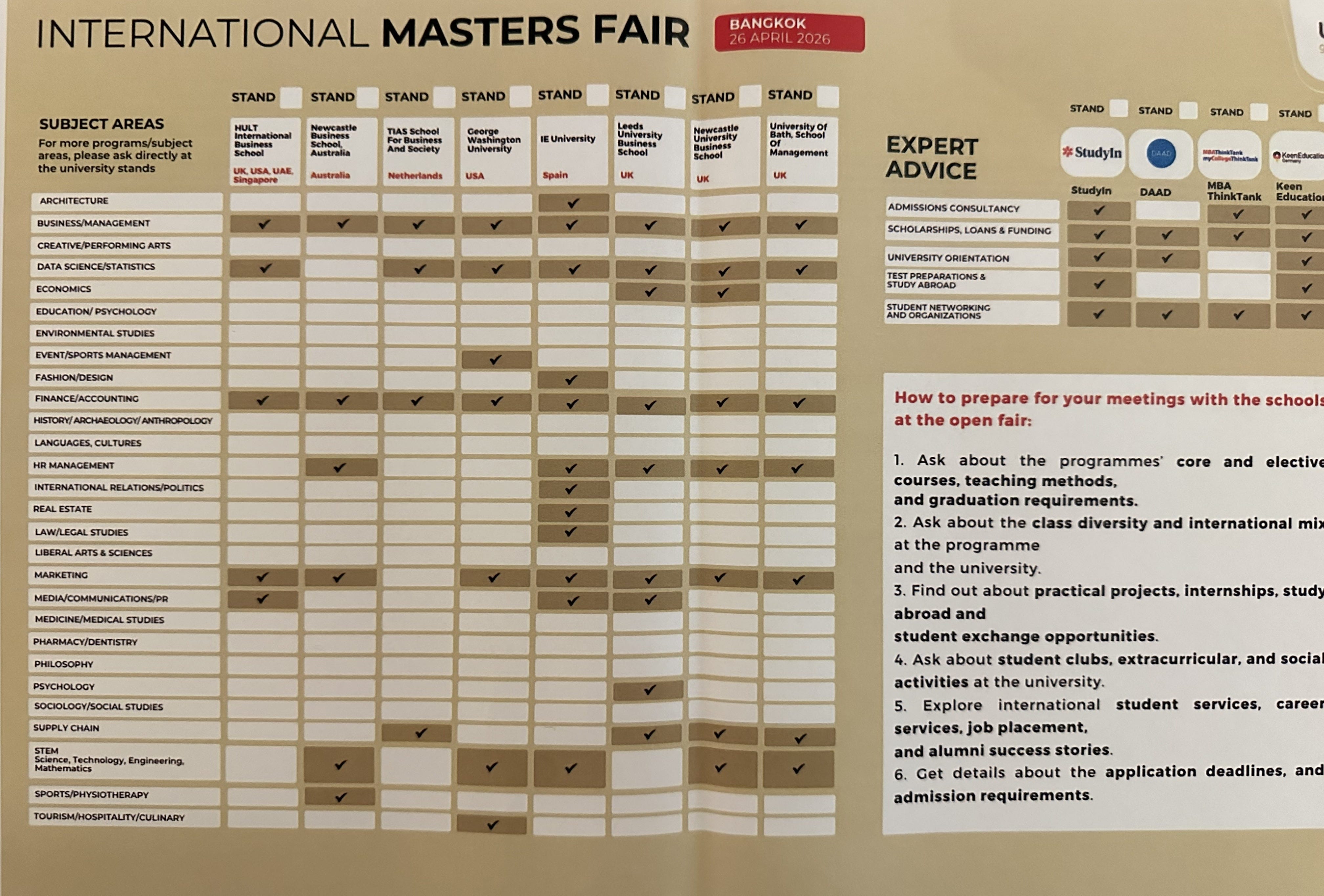
What majors/studies do these schools have? 📚
Zoom in to get all the deets below 👇🏾
Post-school visa support 🛂
Post-school visa support is assistance offered by your graduate university to help you apply for and obtain a visa after graduating, in the hope that you will find work in the country. The work you would need to find would have to sponsor your work visa so that you could stay in the country indefinitely (or, at least as long as you work for a company that could offer you a work visa). Most reputable international graduate programs offer post-school visa support, though it will vary between countries, regions, and even schools.
For example, if you attend a school in a major city in Australia (like Sydney or Melbourne), you can apply for a maximum of 2 years for a post-school visa. If you attend a regional graduate school, you can apply for a 4-year post-school visa. Same country, different offerings. This is why it’s always good to ask the right questions when vetting schools (Candace dives into this below 👇🏾).
Here is a list of what post-school visa support looks like for the Unimy programs:
Hult International Business School (UK): up to 2 years
IE University (Spain): 2 years
Outside of work visas, these are visa types they recommend graduates consider.
Leeds University Business School (UK): up to 2 years
Newcastle Business School, University of Newcastle (Australia): 3-4 years
Newcastle University Business School (UK): up to 2 years
TIAS School for Business and Society (the Netherlands): 1 year
University of Bath (UK): up to 2 years
Scholarships and financial support 💰
There is no uniform amount or way to access scholarships or financial aid when it comes to international Master’s programs, but the vast majority of scholarships abroad offer help. The amount of help and how to tap into it will vary from school to school, so it’s important to know what to ask and who to ask it to. Candace shares more about this in the bonus section below as she was able to move to Denmark by getting an international Master’s degree at Aarhus University.
For some fun, you can see more about Aarhus University in this video below, featuring our babe, Candace, herself! 👇🏾
Some schools have special financial programs for marginalized people and/or to make education accessible to all, regardless of their financial situation. For example, IE University has something called the Laidlaw Foundation that helps marginalized women, specifically, pay for the program they get accepted into. According to the representative I spoke to, this foundation covers between 50-100% of the tuition fees of those accepted into the foundation!
IE also has a list of awards and scholarships that can take off up to 40% of your tuition costs. Basically, there’s money out there; you just need to know where to find it.
🌎Let’s get you outta here!!
P.S. If you’re feeling a little overwhelmed, we’ve got you.
Moving abroad is a lot, and sometimes you just need a sounding board. You can book a personalized consultation with Shayna, Candace, or both of us to talk through your options and get your next steps in order.
No more spiraling, just a solid plan.
Geopolitics and the ability to study and move abroad 🚨
With the rise of conservatism and anti-immigrant sentiments worldwide, being able to immigrate to a country that is leaning further right is only getting harder. In the United Kingdom, there’s been a steady decrease in the amount of post-school visa support. While online most schools say that “up to 2 years” of post-school visa support is possible, one of the representatives was very honest and said that it’s currently closer to 18 months and that it could decrease over time.
This does not just affect your ability to get a visa to look for work, but also your ability to get a work visa, in general. That is not to say that it is impossible to get a visa in a country that is becoming more conservative, but it will be harder for you and your potential employer to prove to the government why you should get a work visa over a local being hired for a position.
This is not specific to the UK. Many other governments are strolling, tumbling, and free-falling down the alt-right pipeline, so you must stay abreast of the geopolitics around the countries you are considering moving to and/or studying in.
Foolproof way to stay long-term in a country after getting your Master’s degree 🏡
Getting a work visa after graduation is your golden ticket. Depending on the country, your time in school and your work visa can be used to help accumulate the years necessary for you to apply for residency, and even citizenship, in a country. While it can feel stressful to navigate this notable educational step abroad, the representative for IE University shared some advice that will lighten the load for all our academically-inclined babes.
“How hungry are you to get a job [post graduation]? You put in what you get out [so] take full advantage of all the support groups offered during your graduate program, including the language classes.”
The representative said that the international graduates who get jobs in Spain and can stay long-term are the ones who learned enough of the language to be conversational and who used all of the resources offered to them. The students who tapped into the networks they needed and absorbed as much information as they could were the ones who got the jobs that allowed them to stay post-school. You have to be a go-getter (in and out of the classroom), or you’re heading back home after school.
Extracurricular support can look like language classes (if the country you are studying in doesn’t speak English as the national language), alumni networks, and advisor meetings. Whatever the school offers to help you get a job post-graduation, take it.

Answering specific questions from our babes: ❔
The Drafts I’d recommend you look into IE University! They have an international relations program and what seems like a solid political science department.
Chatterogue Leeds University not only has an agricultural program, but it also has an on-site farm for the agricultural studies students!
Whitney Unfortunately, the school in the Netherlands doesn’t have an HR Management program :( It does have Business Management, Data Science/Statistics, Finance/Accounting, and Supply Chain.
Zee Northumbria Nursing School was recommended by the rep from Newcastle University (UK). They didn’t have a representative there, but I included the link to their program, in case you were curious.
Someone also had a question about soil science, and I think the closest thing at that conference was the agriculture program at Leeds University.
Thanks again for sending in your questions, and don’t hesitate to follow-up if more questions have emerged.
Last note before I hand this over to Candace 🫴🏾
If your interest was piqued after reading about IE University in Spain, and you’d like some more information, the representative for the university has opened their calendar up for some special Q&A chats with our babes!
Paid subscribers can find the meeting link below, in the VIB (Very Important Babe) section of this article, so if you haven’t joined our babe cave yet, this could be an amazing opportunity to start cashing in on the many special treats we have for you there👍🏾
Okay, now if you’re serious about getting into an international Master’s degree program but don’t know where to begin, Candace has provided some questions that you can use for your own research and for any meetings you have with potential universities.
Think of it as your guide to get the answers you need to find the international Master’s program and country that is best for you.
Candace, take it away…

Serious about studying abroad? Ask these questions 👇🏾
As someone who has received the many benefits of studying outside my home country, and as someone who worked in international study programs professionally, I am so happy to pass along some of the knowledge I scraped and pieced together over the years.
So if you’re just beginning your hunt for the perfect international program, or if you’re ready to book that discovery chat with an international university, here are the questions you should keep in your front and back pockets:
